Years ago, I was invited to serve as a juror for a high school art contest. My category was electronic media. The other jurors were art teachers who all knew each other and had worked together on previous contests. I was the newcomer.
We toured the entries together, taking in hundreds of incredible pieces created by the students. Then, two of the judges stopped in front of one piece in particular. The older juror stroked his chin, with a look of consternation on his face.
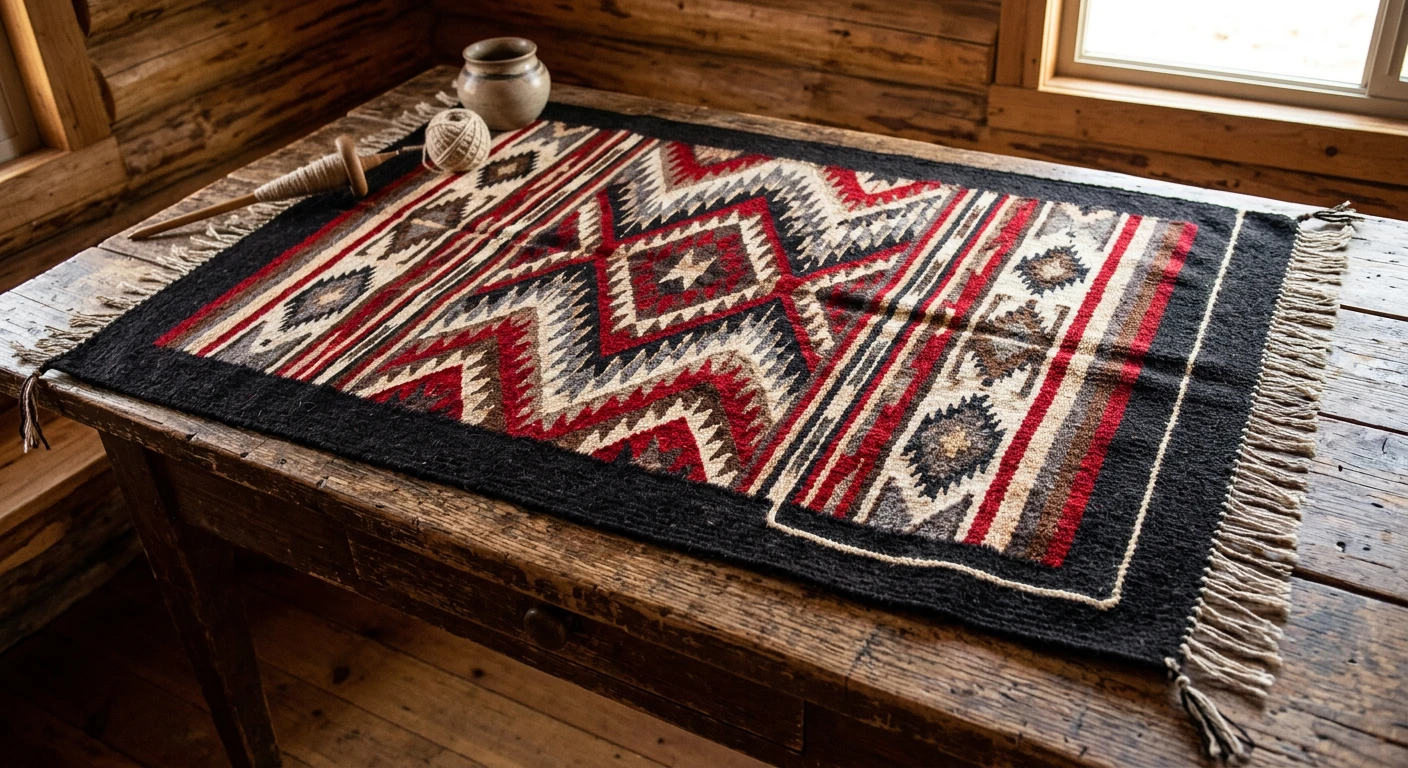
“Hmm. Navajo blankets?” he said to the other juror.
The second one nodded in agreement. “Yeah… Navajo blankets.”
I had no clue what they were talking about, so I asked.
“Navajo weavers would leave small imperfections in their blankets,” the older judge explained. “That way you could tell they were handmade, not machine-made. This piece just looks too perfect. In this category especially, it can be tough to figure out whether the student created the work themselves or just copied an image and applied a Photoshop filter. A few imperfections would make this one a lot easier to judge.”
I've chewed on that moment for years.
And… I also recently learned that the myth isn't true.
Not flaws, but spirit lines
Turns out, many Navajo rugs do carry something unexpected. A thin strand of contrasting yarn running from the heart of the design out through the border to the edge. Weavers call it a spirit line. Some call it the weaver's pathway.
But it isn't a flaw. And it was never meant to prove anything to a buyer.
Tradition says a weaver pours herself into her work. Her thoughts and her creative energy. Part of her spirit. A fully enclosed border would trap all of that inside the finished piece. The spirit line gives her spirit a way out, so her creativity stays free for the work still ahead of her.
The woven line is deliberate and precise. It's placed with intention, usually near a corner. Collectors actually look for it. Nothing about it is a mistake.
It's also relatively recent as traditions go. Classic Navajo blankets (through the mid-1800s) typically had banded, borderless designs, so there was nothing to escape from. Spirit lines only became common in the late 1800s and after, when traders started pushing bordered, rug-style designs for the Anglo market.
The "deliberate imperfection" version is a story told mostly by dealers and admirers. The same myth gets attached to Persian rugs and Amish quilts, and historians doubt it's true in those cases too. The real tradition is something far more interesting. It was never about convincing buyers.
It was about protecting the weaver.
Typos as a badge of honor?
WIRED magazine recently reported that writers are fighting back against AI by adding typos on purpose. Dropping their em dashes. Intentionally roughing up their writing so readers can tell that a human was here. They're calling it a “literary counterculture.”
I understand that impulse. I really do.
But it reminds me of that art contest all over again. And it has the same flawed logic.
I mean, imperfection is the easiest thing in the world to fake. Ten seconds of prompting, and any AI can just sprinkle typos here and there. So the counterfeit shows up almost immediately.
Meanwhile, careful human writers start getting accused of being machines because their writing is too clean. Writers who've used em dashes correctly their whole careers are suddenly suspects.
The “tell” stops detecting AI. It starts detecting polish. Attention to detail. Excellence.
That's what bothered me about the judges' reasoning all those years ago. What if they were wrong? That would mean a student with real, standout skill could produce amazing work that gets disqualified because it's suspicious. Meanwhile, a lazy copy-and-paste job with a little noise sprinkled in sails right through.
The absence of flaws isn't evidence that a human wasn't involved. It's evidence of skill.
What if the student really was that good?
Back at that contest, the suspicions stuck and the piece was passed over. Not because it lacked quality… but because it had too much. Somewhere out there is an artist who may have poured everything into that work and lost because they were too excellent.
And that stings, because I'm a lifelong perfectionist. I pour everything I have into everything I create, and even a blog post like this gets more scrutiny than it probably deserves. I rarely let one out the door without checking and re-checking for grammar and punctuation mistakes. And yes — I've used em dashes for years. Good writers do that. They use every tool available to them.
I'm also fully aware of the flip-side of perfectionism. I've fought with it my whole life. And it took me many, many years to learn how to keep it from paralyzing me. But I still have a high value for excellence. Craftsmanship. The kind of attention to detail that makes people take notice.
Because when we come across something of beauty, something excellent in every way, something carefully crafted, we pause. We sit with it. And we come away inspired.
Because the details matter. And nobody should have to apologize for caring about them.
The weavers were onto something better
The idea behind the “spirit line” points to something really cool.
For the Navajo weaver, the real meaning of her work was never about leaving some mark for a stranger to see. It was always about the relationship between the weaver and the weaving. She was in it. That's the whole point.
So what makes your writing human? Where does the humanity actually come from?
It's not in the typos. It's in you. Your lived experience. Your specific memories. Your stories. Your point of view that came from somewhere real.
AI can fake a typo in seconds. But it can't fake that one afternoon you spent at a student art show, surrounded by awe-inspiring artwork, overhearing a couple of teachers who knew something you didn't. It can't fake your scars or your kitchen-table conversations.
Those are the moments that make us. And AI can't counterfeit them.
So if you're worried about sounding like AI, don't start adding typos to your writing. Don't perform imperfection. Put yourself into the work. Tell the story only you can tell, in the same voice you'd use if you were across the table from a friend.
Nobody can counterfeit that. Not a machine, and not another person, either.
Myths aside, those talented Navajo weavers understood something we're relearning the hard way. The real proof was never the flaws. It was the weaver.


Leave a Reply