I built my first business — a small graphic design agency — completely by myself. On purpose.
Clients would come in, I'd lead the discovery meeting, write the brief, design every comp, push every pixel, and hand-deliver the final files. Oh, and let's not forget billing. Every step. Every detail. Wearing too many hats. All the hats.
At that point in my career, I thought I had to work this way because the value I brought to clients wasn't just one part of the process — it was the whole thing. If I delegated even a piece of it, I'd be diluting what they were paying for. Or worse, I'd be eating into already-thin margins by paying someone else to do work I could do myself.
For a while, that story held up. Until it didn't.
By the time I pivoted to start my second business — creating video tutorials and online training for software companies — I thought I'd learned the lesson. This time around, I'd hire some help.
So I did. I brought in a couple of phenomenally talented online educators. People I respected. People I felt could do every part of the process at the same level I did.
There was just one problem... I was trying to clone myself.
I wanted people who would handle clients the way I did. Write the same way I did. Edit the way I did. I wasn't really delegating — I was outsourcing clones of myself.
It didn't work. In the end, none of us were really happy. And we couldn't tell you why.
The most expensive sentence in your business
For more than two decades, I'd been operating from an unspoken belief that if I was capable of doing every part of the work, I was obligated to do every part of the work. Could I do it? Yes. Then I should.
That's the trap. And it's one a lot of freelancers and entrepreneurs I work with are still operating under without realizing it.
It sounds perfectly reasonable. You're good at a lot of things. In fact, you're a multi-talented dynamo, which is why you're wearing too many hats. When the business needs things done — the buck stops with you. So you keep saying ‘yes’ to work you can do, and slowly the work you actually love gets pushed to whatever's left of your week.
The most expensive sentence in your business just might be: “I can do that, too.”
Because the moment you say it, you've made a decision that costs you time, money, and energy. But more than that... it sets you on a path to burnout.
It took me far too long to see what was happening
When I look back at those two businesses now, with the benefit of what I know about how I'm actually wired, I can't believe I missed it.
The parts of the work that came alive for me were almost always at the front end of a project. Sitting with a client, peeling back the layers of why they got into this in the first place. What set them apart from the competitor down the street. Asking the questions nobody had asked them in years — “Why did you start this business? What does your audience actually care about? What's the story underneath the one you've been telling?” Walking away with a crystal clear picture of where we needed to go, what they needed most.
That's the work that lit me up. I'd loved those conversations and walked out of them more energized than when I went in.
Then came the hard part — sitting in front of my computer, pushing pixels for the next four days, or scrubbing through hours of footage to produce a tutorial video — I was good at those things. Sometimes excellent. And my clients loved the final product. But it was costing me something every time. And the more time I spent at my computer, the heavier I felt.
I never stopped to ask which parts of my own work were doing what. I just assumed that because I could do all of it, I should do all of it.
That's the mistake lots of entrepreneurs make. You can be incredibly skilled at the entire process — while only deeply satisfied by one slice of it.
What wearing too many hats actually cost me
There were two hidden costs I didn't see until much later.
The first was personal. I burned out. Twice. Not because I was working too many hours — though I was — but because I was spending most of those hours doing the parts of the work that fit me least. The discovery and conceptual work that energized me most only made up maybe ten percent of any project. The other ninety percent required high skill, high attention to detail — and was slowly draining me.
The second cost was bigger and harder to see: my business grew much slower than it could have. While I was buried in execution work, I wasn't out building new client relationships, having those interesting discovery conversations, or exploring bigger visions for bigger projects. The very work that energized me was also the work that would have grown my business the fastest. I was rationing it because I thought I had to do everything else first.
A question I'd like you to sit with
If you're wearing too many hats, the typical advice is to figure out what to delegate. Create a “Stop Doing” list. But I don't think that's the right question to start with.
A better one might be this:
Within the work you do every week, which slice of it do you find most meaningful, rewarding — and pays you back?
Not which parts you're good at. Or which parts you can do better than others. I'm talking about the parts you walk away from feeling energized, most alive, deeply satisfied.
Most entrepreneurs have never taken the time to separate their work that finely. They look at it through the lens of whole jobs — I'm in marketing, I'm in operations, I'm in sales — when the truth is every job has slices that fit and slices that don't. And those slices that fit are usually a much smaller portion of the week than you'd think. Oh, and they're the ones that are almost always under-protected.
When you can name those slices clearly, two things change:
- You stop letting them get crowded out by work you can technically do.
- You start to see — sometimes for the first time — what your business would look like if you spent more of your week there.
One more hidden cost to think about
When I was hoarding all the work in my business, I told myself it was because I could do it better than a junior employee. Looking back, it was also about control.
What I didn't see at the time is that by gripping every part of the process, I was also robbing someone else of a chance to discover their own deeply fulfilling work. Someone who would bring their own unique strengths and capabilities to the table. Whose own work would've made them come alive.
I was so busy trying to clone myself, I never made room for others to find out what they were actually built for.
That's a different post for a different day. But it's worth saying here, because the trap of wearing too many hats doesn't just cost you. It also costs the people who could be working alongside you, too.
“Okay, so where do I start?”
My suggestion is: don't try to fix it all at once. This week, pick one project on your calendar and ask yourself, honestly, which slice of it actually fits you. Then ask which slice you've been doing on autopilot just because you can.
That gap is where the real work begins.
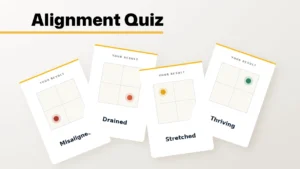
If you're wearing too many hats and you'd like help figuring out which parts of your work actually fit how you're wired and which parts have just been quietly costing you — I'd love to talk! Grab a free 30-minute call on my calendar. No pitch, no obligation. Just an honest conversation about where the misalignment is showing up and what you can do about it.