When we talk about motivation, most people think of a temporary feeling, the kind you get after watching a TED talk or reading an inspirational book. MCode measures something that runs deeper.
When you work in line with your natural motivations, you have a different kind of energy. That’s why some tasks leave you energized after hours of focus, while others wear you out in minutes.

How does MCode work?
The assessment is online and takes about 30 minutes.
Share four stories
You’ll write about four times in your life when you did something well and enjoyed doing it. They can come from any part of your life.
Rate what satisfied you
For each story, you’ll rate a set of statements on how satisfying each part of the experience was.
Get your report
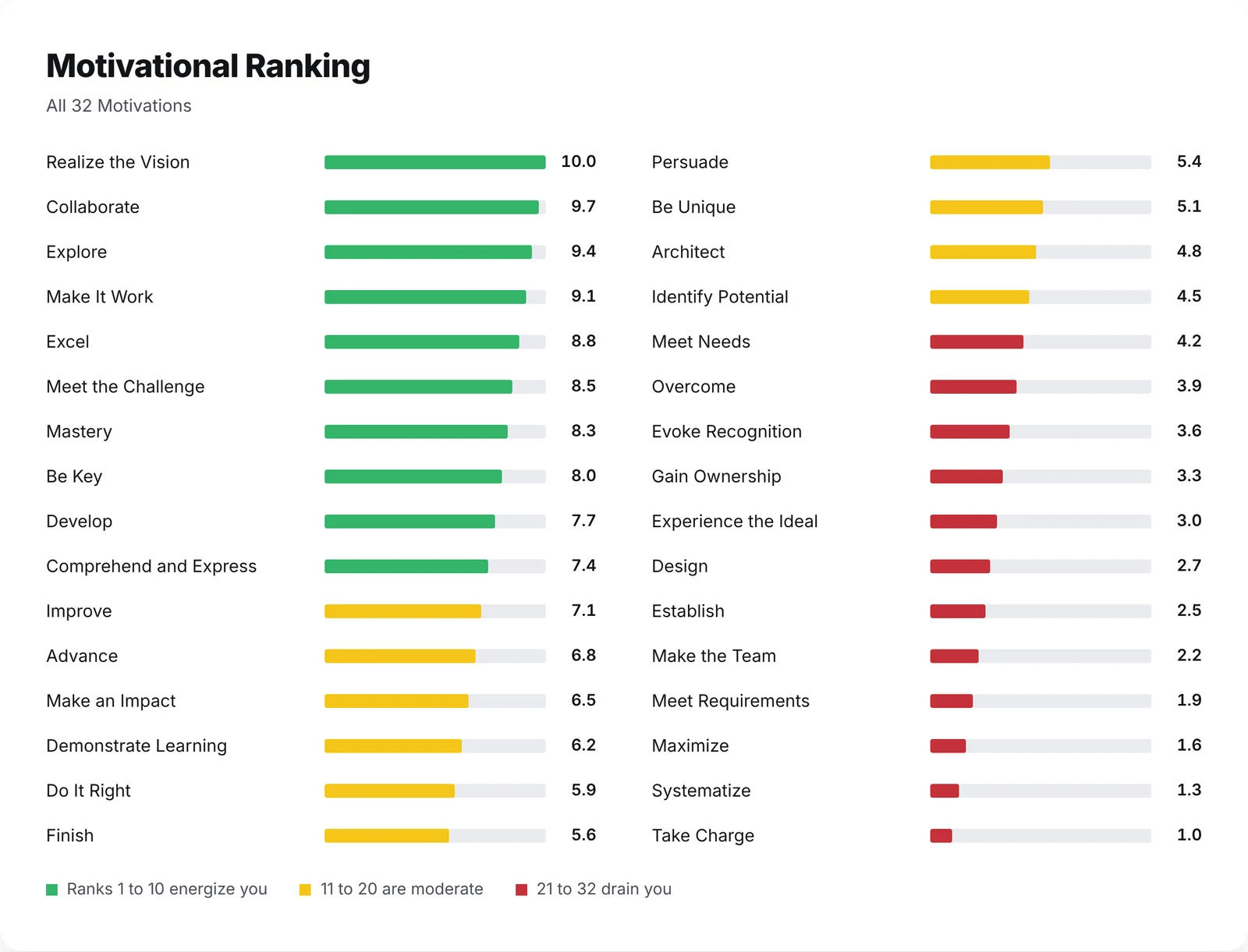
MCode ranks all 32 Motivations for you, from most satisfying to least satisfying, and groups them into 8 Dimensions.
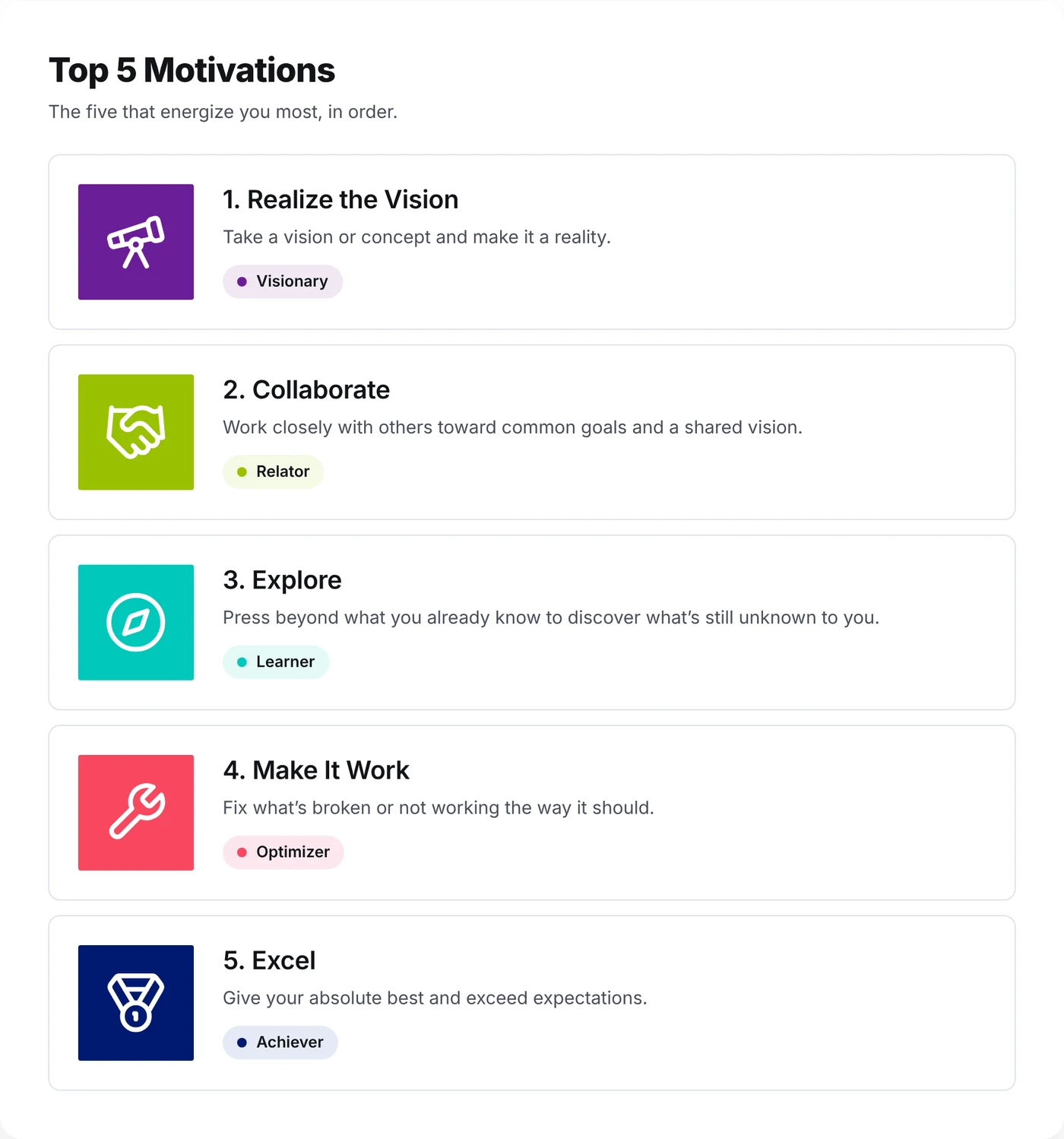
Everyone has all 32 Motivations. What differs is the order. The Motivations at the top of your ranking energize you. The ones near the bottom describe work you can do, and may even be very good at, that drains you over time.
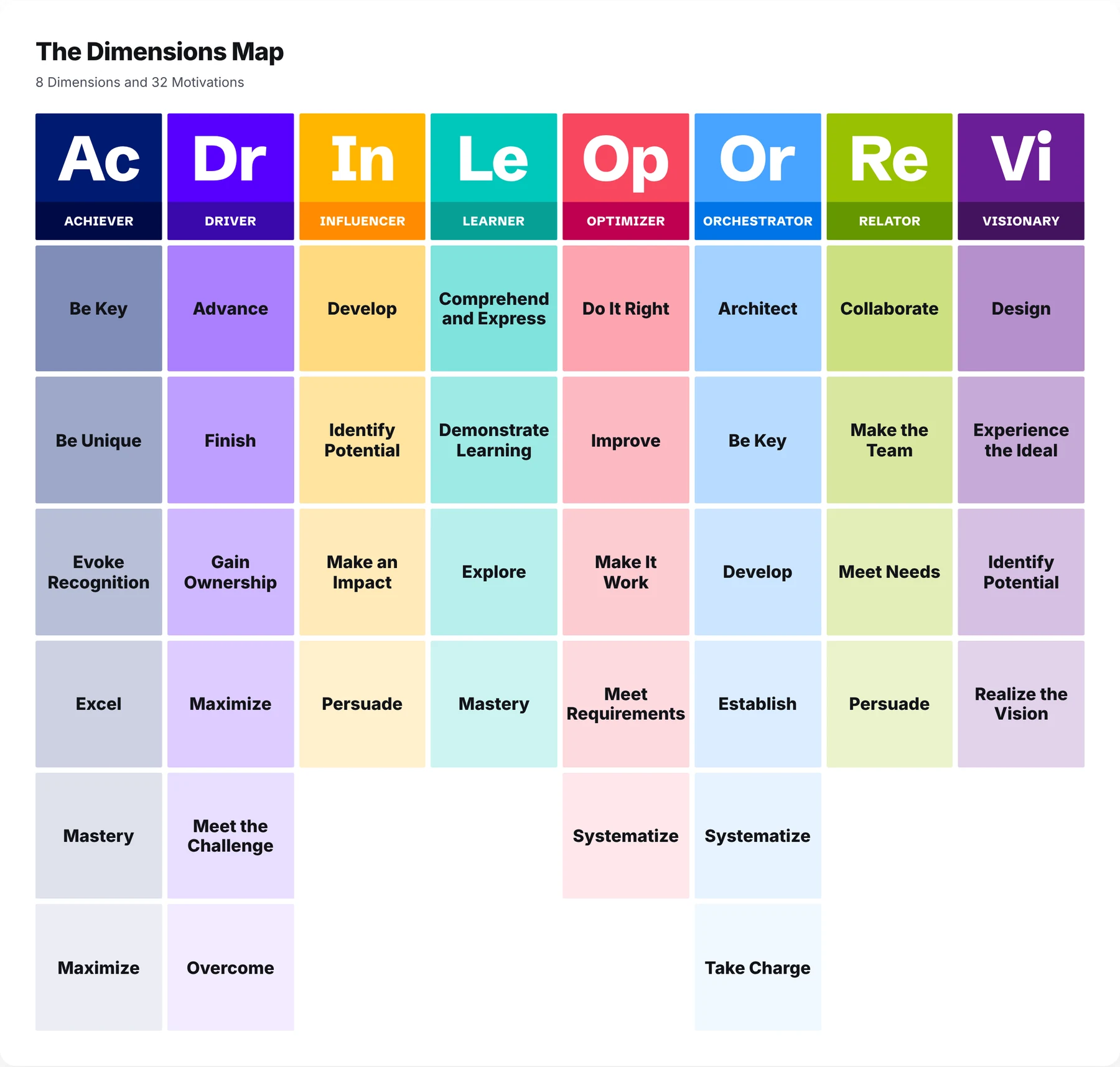
The 8 Dimensions
The 32 Motivations are grouped into 8 Dimensions. A Dimension is a family of related Motivations, and it shows how you relate to people who are motivated differently.
It started with achievement stories
MCode’s history starts with Bernard Haldane, who is often called the founder of modern career counseling. In 1947 he opened a job counseling firm in New York. That same year, the Harvard Business Review published his article “A Pattern for Executive Placement.”
Haldane didn’t start with a résumé or a job title. He asked clients about their past achievements and looked for the skills they most enjoyed using. He summed up his idea in one line.
“People who enjoy their work, do it better.”
In the late 1950s, Arthur Miller Jr. was working with Haldane, and he took the idea further. As he studied his clients’ accounts of their most satisfying accomplishments, he saw recurring themes. He called the whole pattern of motivated behavior a Motivational Pattern. By 1961 he was using the method with clients.
His method became known as SIMA®, the System for Identifying Motivated Abilities®.
What is SIMA?
SIMA is a narrative-based approach to understanding motivational patterns. It works with your real experience, in your own words. It revisits moments in your life when you felt joy, success and satisfaction.
It draws on four established fields.
- Phenomenology. SIMA works with lived experience. People describe their own stories.
- Narrative psychology. People partly shape their identities through the stories they tell.
- Appreciative inquiry and positive psychology. SIMA looks at where people work well and builds on their motivated gifts.
- Solution-focused practice. SIMA helps people bring their own resources to bear on real circumstances.
Miller’s contemporaries and collaborators included Richard Bolles, author of What Color Is Your Parachute?, and leadership coach Marshall Goldsmith. The Miller family is still deeply involved in SIMA-related work today.
How organizations used SIMA
Over six decades, SIMA practitioners analyzed more than one million achievement stories. At its peak, 22 licensed consultancies in the United States, England, Sydney and Amsterdam used SIMA’s tools for executive search, succession planning, leadership coaching and organizational development.
NASA used it with more than 150 managers, and to simplify a national program for recruiting 3,000 scientists and engineers. IBM used it for many years to help engineers decide whether management was right for them. More than 600 nonprofits used it too.
The process worked. It was also intensive, highly customized and hard to offer widely.
From SIMA to MCode
In 2010, Rod Penner and Tony Kroening set out to automate the SIMA process and keep all of its depth. Dr. Peter Larson, a counseling psychologist with deep experience building assessments, joined them.
Arthur Miller III and Dr. Joshua Miller, the son and grandson of SIMA’s founder, worked with Peter to adapt the SIMA glossary into a self-report assessment. Their prototype captured people’s achievement stories, then asked how satisfying each experience was across a set of motivational statements.
Dr. Todd Hall, a clinical psychologist, led the research that tested it. Now anyone can complete the assessment online in about 30 minutes.
In 2022, MotivationCode.com acquired all of SIMA’s intellectual property. We expanded the framework from 27 to 32 Motivations and grouped them into 8 Dimensions. Today the research base includes more than 1.8 million achievement stories from people around the world.
Why stories?
Most assessments ask you to rate statements about yourself or imagine how you’d act in a made-up situation. Those answers depend on how you see yourself on the day you take it.
MCode asks for real stories from your own life, so your results rest on what you actually did. Psychologists have studied this for more than 70 years. In 1953, David McClelland and three colleagues published The Achievement Motive. They found that what people produce on their own reveals more about their motivation than how they rate statements someone else wrote.
One story tells you about one moment. When the same themes show up across four stories from different parts of your life, you’re looking at something lasting.
How consistent are the results?
Dr. Todd Hall, Dr. Joshua Miller and Dr. Peter Larson tested MCode’s reliability with two groups, a national panel of 347 people and 306 MCode clients. They used a measure called Cronbach’s alpha, which checks whether the questions about each Motivation agree with each other. A score of .70 is the usual minimum. In both groups, the average across the original 27 Motivations was .80, which is rated good.
An earlier study points the same way. In 1989 and 1990, vocational psychologist Dr. John Crites ran seven studies on SIMA against the American Psychological Association’s testing standards. He found that a person’s Motivational Pattern stays stable over time.
How MCode fits with other assessments
Other tools describe how you behave or what you’re good at. MCode explains the motivation underneath your choices. That’s why it works well alongside CliftonStrengths, DiSC, the Enneagram and other assessments you may already know.
Your personality may shift over the years. Your motivational pattern is set early and stays stable. MCode never compares you with anyone else. Your ranking shows the order of your own Motivations.
If you’d like to see your own ranking, take the assessment. I’d love to walk through your results with you.